Showing posts with label Appendix A. Show all posts

March 28, 2013

The Company of Thorin Oakenshield

I have Danania from "The Adventures of Danania, Supergirl of Lorien" blog to thank for this fantastic post idea!  I don't know how this didn't occur to me before now, so double-thanks to you for hitting me over the head with this one!

Who exactly are all of the Dwarves who were in the company of Thorin Oakenshield, what was their relationship to each other, where does the doughty Gimli fit in, and where (if anywhere) do we find them (or references to them) in LOTRO?

I briefly touched on this in my post on Goblin Town last December, and even speculated about whether we would see some of the surviving Dwarves when we made it to Erebor.  And sure enough, we now have some answers!  But I never really took an in-depth look at them, and the roles they played in the Hobbit or how Turbine integrated them into LOTRO.  What a fun topic!

OK, before you read any further, count off all of the Dwarves by memory.  A chocolate chip Cram for each of you who can!  Thanks to the Hobbit movie, it definitely helps many of us remember them.  Here's a list, just because I find it fun to make such a list:

  1. Thorin Oakenshield
  2. Balin
  3. Dwalin
  4. Fili
  5. Kili
  6. Glóin
  7. Óin
  8. Dori
  9. Nori
  10. Ori
  11. Bifur
  12. Bofur
  13. Bombur

Cool, I didn't even have to look to do that.  And there's even a bit of logic (at least in my mind) in how I have them ordered.  Thorin, Balin, Dwalin, Fili, Kili, Glóin, and Óin are all related (as I'll discuss below), and are all descendants of Durin the Deathless.  Take a look in the Appendix, as there's a nice genealogical chart that is far better than anything I could create.  Dori, Nori, and Ori are also mentioned as being part of the House of Durin in Appendix A but more remotely related to the others.  Bifur, Bofur, and Bombur are said to be descended from Dwarves of Moria but not of Durin's line.


Thorin's Hall, as viewed from Frerin's Court
Thorin Oakenshield

We all know him - Thorin, leader of the party to reclaim Erebor.  Thorin was a descendant of Durin I, the first Dwarf to awaken on Arda, and would have been in line to become King under the Mountain following his grandfather, Thrór and father, Thráin II.  He's actually Thorin II; there was another King Thorin I about 500 years before our Thorin.

In The Hobbit, Thorin is described as wearing a sky-blue hood with a long silver tassel, and plays the harp.

After Smaug routed the Dwarves from Erebor, Thorin later settled in Ered Luin and founded the area of Thorin's Hall.  In LOTRO we see Frerin's Court is named after his younger brother, who was killed in the Battle of Azanulbizar while trying to take back Moria and avenge the murder of King Thrór by the orc Azog.  Just beyond the gates near Frerin's Court, you enter the Vale of Thráin, named after Thorin's father.  (I guess he did not feel the need to name anything in Ered Luin after his grandfather, who got Thrór's Coomb in Enedwaith as his namesake.)  Thorin of course dies from wounds received during the Battle of Five Armies, and is laid to rest deep under the Lonely Mountain, with the Arkenstone on his breast and Orcrist the sword laid atop his tomb.  We can barter at skirmish camps for a nice bust of Thorin to add as a housing decoration!


Balin and Dwalin


Balin's Tomb
Balin and Dwalin were brothers, sons to Fundin, and distant cousins to Thorin, as well as first cousins to Glóin and Óin.  I have to say, I found the first Hobbit movie adorable; yes I'm a Lore Junky, but I have no problems with what Jackson did in order to adapt it to the big screen (and I just have fun telling my son the REAL lore when they get it wrong lol).  I get a kick out of these two guys and they are absolutely my two favorite Dwarves in the movie!

In the book, both play large viols.  Dwalin wore a green hood and Balin a scarlet one.

In LOTRO, Dwalin is now ruling in Thorin's Hall, working to defend Ered Luin.  We meet and assist him during the introductory section for Elves/Dwarves, and then can stop by to see him at any time at his seat at Thorin's Hall.  Just remember that he does NOT like sugared honeysuckle candy.


Dwalin
In The Fellowship of the Ring, we first hear of Balin when Frodo and Glóin are dining together, and Frodo asks what had become of Balin, Ori, and Óin, who went to Moria together.  "A shadow passed over Glóin's face. 'We do not know,' he answered.  'It is largely on account of Balin that I have come to ask the advice of those that dwell in Rivendell."  It was 30 years before the time of the War of the Ring that the 3 Dwarves took a company to resettle Moria.

Gandalf reads what he can from the book in the Chamber of Mazarbul:  "The first clear word is sorrow, but the rest of the line is lost, unless it ends in estre.  Yes, it must be yestre followed by day being the tenth of novembre Balin lord of Moria fell in Dimrill Dale.  He went alone to look in Mirror mere.  An orc shot him from behind a stone.  We slew the orc, but many more...up from east up the Silverlode....Poor Balin!  He seems to have kept the title that he took for less than five years."


We unfortunately know all too well what happened to Balin.    He was entombed in the Chamber of Mazarbul, or the Chamber of Records, which had been established as his seat in Moria, and was later discovered by Gimli and the rest of the Fellowship during their journey through the Mines.


Fili and Kili

Fili and Kili were brothers, and nephews of Thorin.  Their mother, Thorin's young sister, was the sole named female Dwarf that we know of from the Hobbit - Dís.  Fili and Kili were killed at the Battle of Five armies, trying to defend Thorin "with shield and body."  With their deaths, thus ended this particular line of the House of Durin; neither Thorin or his brother Frerin had children.

Oddly these two Dwarves are not - thus far - worked in to LOTRO in any manner that I can recall.

In the book Fili is noted as having the best sight.  Both wore blue hoods, silver belts, and had yellow beards, and played little fiddles.


Glóin and Óin


At Glóin's Camp
Glóin and Óin were brothers, wore a white and brown hood respectively, and were cousins to Balin and Dwalin.  Their father was the unfortunately named Gróin, who was brother to Fundin, dad of Balin/Dwalin.  (Really, just look at the chart in Appendix A, it is so much easier!)  And of course Glóin is dad to our favorite LOTR Dwarf, Gimli.  So Gimli is indeed of the line of Durin!

The two brothers were reputed in the book to be particularly skilled at building fires, but do not seem to have been musical, unlike the other Dwarves.

Glóin is alive and well in LOTRO, and can be found at the camp named after him just north of Rivendell, as we pass into the Misty Mountains.  Glóin has been protecting the passes of the  mountains, and has much business for us to take care of in Goblin Town.


The Remains of Óin
Óin, on the other hand, was not so fortunate.  After Erebor, he elected to accompany Balin in his attempt to recolonize Moria.  From the book found in the Chamber of Mazarbul, we learn that Óin was killed by the Watcher in the Water.  And sure enough, we get to meet him - er, his remains - when doing both Volume II and wrapping up Volume III of the Epic Book line.  The fabled axe that belonged to Durin, what LOTRO calls Zigilburk, is closely tied to the fate of Óin.


Dori, Nori, and Ori


In the movie, these three Dwarves are brothers.  Did you know that in The Hobbit book, no mention is made of their actual relationship?  Maybe they are related, maybe not.  Curiously, Dori and Nori both wear purple hoods in the book, with Ori wearing a grey one.  All three played the flute.

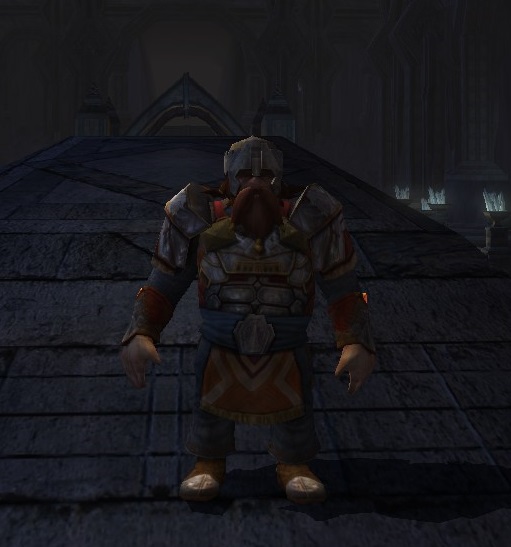
As stated earlier, Ori accompanied Balin to Moria, where he met his end with the others.  In LOTRO we see him in a session play during the Volume II epic line, "We Cannot Get Out."   It was Ori who recorded the last moments of the Moria settlers in the book of Mazarbul. 

Captain Ori in "We Cannot Get Out"
"Here is something: a large bold hand using an Elvish script. 'That would be Ori's hand,' said Gimli, looking over the wizard's arm. 'He could write well and speedily, and often used the Elvish characters.'"

"We cannot get out.  We cannot get out.  They have taken the Bridge and second hall.  Frar and Loni and Nali fell there....the pool is up to the wall at Westgate.  The Watcher in the Water took Óin.  We cannot get out.  The end comes...drums, drums in the deep...they are coming."

In The Hobbit book, Dori is noted to be the strongest Dwarf, and most often looked after Bilbo, often having to carry or assist him.  Dori was actually carrying Bilbo through the darkness of the caves of Goblin Town when he tripped and dropped Bilbo, who rolled off unconscious and unseen in the blackness, later making his way to Gollum's lair.  Dori also saved Bilbo from the Wargs by letting him jump on his back to climb up the tree, almost at his own peril.  He also took a lot of heat from the others for supposedly putting their "Burglar" in peril.

Dori and Nori at the Battle for Erebor
In LOTRO, we get to see Dori during the introductory session for Elves/Dwarves, in Frerin's Court with Dwalin.  We also encounter him later in the North Downs, where he has been imprisoned in a fortress near Othrikar, then later shows up in Esteldin.

We also see both Dori and Nori at the entrance to the new Battle for Erebor raid!


Bifur, Bofur, and Bombur

Bofur and Bombur are brothers, and cousins to Bifur.  Bifur and Bofur wore yellow hoods, and Bombur a green one.  The former two were talented with the clarinet, while Bombur played a drum.
 
Bifur and Bofur Fight the Fires of Smaug

All three survived the Battle of Five Armies, and prospered at Erebor, though in perhaps different ways.  As we learn in the Fellowship of the Ring, "Bombur was now so fat that he could not move himself from his couch to his chair at table, and it took six young Dwarves to lift him."  In LOTRO, we have not yet seen or heard much of Bombur, except in a possibly very appropriate way - the Bombur's Beard ale is named after him.  (There is also a fake version, Bombur's Breath, available from the Ale Association.)

In LOTRO, we meet cousins Bifur and Bofur at the entrance to the new Fires of Smaug raid.  (I'm sorry, but that raid - ugh.)

Interestingly, in LOTRO we see other traces of Bifur and Bofur in Moria.  Remember all of the "B" Dwarves you help throughout Moria?  The Devs created Bori, who is the son of Bosi, son of none other than Bifur!  And we can infer that Brogur, who is the father to Bróin, is the son of Bofur.  Bosi refers to Brogur as his cousin (and we are sort of tipped off by the name of a quest that Bosi confers named "Cousin Brogur.")  Bori also calls Bróin his cousin.  I believe Brogur, in the instance "Zigelburk Returned,"  refers to Óin as a "friend to my father."

Whew.  Those are a lot of Dwarves to incorporate into LOTRO, and a lot of Dwarves to keep track of!  I have very much enjoyed how LOTRO has found ways to keep the Company alive - either truly alive or in memory.  (What about Fili and Kili?!)  So have I missed anything?  Let me know!


References:  The Fellowship of the Ring, The Hobbit, The Lord of the Rings Appendix A

March 22, 2013

Lore in the Classes: Minstrel


The LOTRO Lorebook tell us that the Minstrel class was "inspired by Lúthien Tinúviel, whose Elven voice beguiled friend and foe alike."  They have skills such as Cry of the Valar, Call of Oromë, Invocation of Elbereth, Song and Gift of the Hammerhand - from what or whom do all these names come?

Let me start by taking several steps back, which is quite necessary when talking about many Minstrel skills and where they come from.  I mean way, way, way back to the start of things as chronicled by The Silmarillion!


In the beginning, there was Eru. "There was Eru, the One, who in Arda is called Ilúvatar; and he made first the Ainur, the Holy Ones, that were the offspring of his thought, and they were with him before aught else was made.  And he spoke to them, propounding to them themes of music; and they sang before him, and he was glad."


Ilúvatar is the monotheistic creator entity of Tolkien's world.  He created this group of spirit beings called the Ainur, for whom music was their first and foremost means of expression and action.  Then Ilúvatar revealed his great plan to them and bade them "make in harmony together a Great Music," whereby the "voices of the Ainur, like unto harps and lutes, and pipes and trumpets, and viols and organs, and like unto countless choirs singing with words" created a music that began to fill the Void (I don't think Eru had invented the Pibgorn yet).  As Ilúvatar later showed them, the Void was no longer void, but a new World had appeared of their creation.  Ilúvatar showed them a vision of what this world, Arda, could be like, populated with the Children of Ilúvatar, who would be the first Elves and Men.  Throughout the first pages of The Silmarilion music - harmonies, melodies, parts -  is the critical ingredient in creating and expanding the Universe of Ilúvatar, and also is the means to introduce the first strife and tension.  Because of their musical skills Minstrels are tapped into the foundations of creation; little wonder that their skills can give so much healing.


Some of the Ainur were so taken with the idea of Arda and the Children of Ilúvatar that they wished to help this new creation develop, and were bound to Arda by Ilúvatar so "that their power should thenceforward be contained and bounded in the World, to be within it for ever, until it is complete, so that they are its life and it is theirs. And therefor they are named the Valar, the Powers of the World."


There were originally 15 Valar, each generally "in charge" of a specialty based on what part of Ilúvatar was put into them when they were created. For example, Ulmo was the Valar connected with water; Aulë the one who built landmasses, gems, ore, and created crafting (and also created the race of Dwarves). However, one Valar was more of a "generalist" with a broad understanding of the knowledge of all the other Valar, and was more powerful than the others. His name was Melkor, later known as Morgoth.


The Valar often had "companions" of "lesser Ainur," who became known as the Maiar, who would learn the expertise of their Valar tutors. The Wizards in Middle Earth were Maiar. Gandalf, originally known as Olórin, was most associated with Manwë and Varda, the "leader" of the Valar and his "wife," who is also known as Elbereth. Radagast the Brown was associated with the Valar known as Yavanna, the "Giver of Fruits" who loved all the things growing on Arda. Curumo (Curunír, or Saruman) and even Sauron (yes, he was of the Ainur) were associated with Aulë, at least initially. Melkor, who is no longer counted as one of the Valar because of all his naughtiness, corrupted several Maiar who later became Balrogs. Kind of interesting connections being made now, huh?


So back to Lúthien Tinúviel - she was the daughter of King Thingol, one of the Eldar, and his wife Melian, one of the Maiar. Basically,Lúthien liked to dance and sing a lot and was pretty good at it. She fell in love with Beren, a mortal Man. King Thingol, who like so many dads in Middle Earth want the guys interested in their daughters to first prove themselves, sent Beren on an ambitious quest to steal a Silmaril from the crown of Morgoth. When Lúthien discovered this, she went to help him, which was fortunate as Beren had been captured by Sauron, who was now a servant of Morgoth. She then helped Beren later to obtain the Silmaril, singing a song that distracted Morgoth and his minions, keeping them from realizing what was happening until it was too late. (Sounds like Song of Distraction, doesn't it!). As often happens in such stories, Beren and then Lúthien died soon after, but her singing as a spirit brought them both back to live out long lives. Elrond is descended from Beren and Lúthien, as was his brother Elros. And that means that far, far down the line, so is Aragorn.


Varda, or Elbereth, as mentioned above is the spouse of Manwë, the "leader" of the Valar. Together their powers complemented each other. Elbereth created the stars and constellations, and is also called Gilthoniel, or "Star Kindler" (not "Stir Kindly" if you listen to the tipsy Elves near the Vineyards of Lorien). She was said to be the most beautiful being, and became the favorite Valar of the Elves. For a Minstrel, calling upon her name will cause mobs to run in fear - a bit of an odd choice for such unsurpassed beauty, but there's no accounting for the taste of the minions of Morgoth.


As for the Song and the Gift of the Hammerhand, I already mention the noble behavior of Helm Hammerhand in my post "A Dunlending and Rohirrim Romance" found here. As the skill text describes, "the name comes from the adage that those who know this lay were said to have been able to take a blow from Helm Hammerhand himself." Not the most admirable behavior in a guy so revered by the Rohirrim, but that's probably why they hold some of the prejudices that they do.

Call of Oromë - "sheer lightning cleaving the clouds"

Once during one of my annual readings of the Lord of the Rings, I was flipping through Appendix A and came across a name that jumped out at me.  I had been playing my Mini frequently, and absolutely recognized the name Oromë from the skill Call of Oromë ("This piercing call, a lesser echo of one used long ago by Oromë the Great, demoralizes a group of your foes and reduces their resistance to further attacks."). In a teeny tiny little footnote, I read: "The wild kine that were still to be found near the Sea of Rhûn were said in legend to be descended from the Kine of Araw, the huntsman of the Valar, who alone of the Valar came often to Middle-earth in the Elder Days. Oromë is the High-elven form of his name." The footnote also refers the reader to the last page of the chapter "The Ride of the Rohirrim" in The Return of the King, where Éomer says: "Fey he seemed, or the battle-fury of his fathers ran like new fire in his veins, and he was borne up on Snowmane like a god of old, even as Oromë the Great in the battle of the Valar when the world was young."


Oromë was one of the Valar, described as a "mighty lord" in The Silmarillion.  It was said he loved the lands of Middle Earth, and was the last of the Valar to go to Valinor.  He was a lord of the hunt, loved all trees, and horses, and hounds.  His steed was named Nahar, and thus is revered by the Rohirrim, who said the mearas must have been descended from horses brought by Oromë out of the West. He also carried a great horn called the Valaroma. The horn is described as being heard above all other horns, "the sound of which is like the upgoing of the Sun in scarlet, or the sheer lightning cleaving the clouds." 

Oromë it was who first encountered the Elves soon after they awoke, and called them Eldar.  Interestingly, it seems that Morgoth, or Melkor at that time, was aware of the awakening of the Elves before any of the Valar, and so through either disguised minions and/or rumors, caused some of them to fear Oromë as being a dark, shadowy hunter who would come to steal them.  The fact that solitary or small groups of Elves who ventured too far from their original home would disappear, never to be seen again, bolstered this notion.  And these, according to The Silmarillion, were the Elves who were taken captive and slowly broken and corrupted by Melkor, thus leading to the race of Orcs "in envy and mockery of the Elves."


References:  The Lord of the Rings: Return of the King, Appendix A; The Silmarillion; Unfinished Tales


December 15, 2012

Down, Down, to Goblin Town!

With the U.S. release of The Hobbit movie this weekend, how could I not focus on Hobbit-related content?  And what better place to do so than Goblin Town?  Ho, ho, my lad!

I have been re-reading The Hobbit in anticipation of the movie, and numerous times I have been struck with how well LOTRO incorporates descriptions from that book, such as Thorin's party making their way toward Rivendell.  My very first time I tried to find Rivendell, attempting a run on a much-too-small Hunter, I encountered my first real "roadless road" and got horribly lost as soon as I crossed the Bruinen.  And it took me several journeys before I finally grasped the way; the pathless, steep and wild slopes heading higher and higher into the mountains are dead on.  Sure, it seems clear enough now, but I was constantly getting lost at first!

The Black Crack
They did a fantastic job with Goblin Town, filling it with references to The Hobbit that are great fun for fans to encounter.  And of course we will get to see even more with Update 9 this Monday.

As it is now, it's a formidable place for toons in the upper 40's-50's, and can be a tedious maze even for level 85's who can otherwise pass unmolested.  It is also the perfect place to farm Rivendell reputation drops as well as pick up some interesting armour and shields with unique appearances.  Be sure to empty your bags before you go!  I have taken a few toons through to finish all of the quests and deeds now, and use a fantastic map I found on the LOTRO Vault website.

If we prepare properly for our trip to Goblin Town, we get to pick up some quests from old friends from The Hobbit before we leave.  We get to talk to Gloin and Dwalin before heading out.  Bilbo certainly has some special requests for us to take care of on his behalf.  One of his tasks starts a deed where we get to collect the buttons he lost while squeezing through a doorway to escape from Gollum and Goblin Town, which I have always thought to be one of the most charming connections to The Hobbit. "It was still ajar, but a goblin had pushed it nearly to.  Bilbo struggled but he could not move it.  He tried to squeeze through the crack.  He squeezed and squeezed, and he stuck!  It was awful.  His buttons had got wedged on the edge of the door and the door-post.... He gave a terrific squirm.  Buttons burst off in all directions.  He was through, with a torn coat and waistcoat, leaping down the steps like a goat, while bewildered goblins were still picking up his nice brass buttons on the doorstep."

Ever wonder what happened to the other surviving Dwarves from Thorin's expedition?  Wouldn't it be wonderful to encounter them at some point as well?  We were able to play as the doomed Ori during the session play "We Cannot Get Out."  We also got to encounter Dori briefly at a few points in LOTRO.  We know that Bifur, who survived the Battle of Five Armies and supposedly stayed in Erebor, is dad to our Bosi and granddad to Bori of LOTRO Moria fame.  And of course we see an ale called Bombur's Beard.  I wonder if any of the other survivors will be found in the new Erebor instances/raids that are slated to be released in the spring?  Several of them supposedly stuck around that area after the Battle of the Five Armies.

At any rate, back to Goblin Town!  Most know there are two routes in:  One through the Mountain's Throat and one through the more hidden Black Crack.  As the book states, "That, of course, is the dangerous part about caves: you don't now how far they go back, sometimes, or where a passage behind may lead to, or what is waiting for you inside."  Indeed.

Once inside we discover that Goblin Town is, naturally, again filled with Goblins.  There's a new Great Goblin in charge, with terrible posture.  And these Goblins and their friends have not forgotten how Thorin and company killed their prior Great Goblin, gave them the slip, and then trounced them during the Battle of Five Armies.

Out of the frying pan and into the fire.
Deep inside Goblin Town can be found some wonderful cave art created by the goblins.  One picture commemorates a particularly frustrating moment for them, after the Dwarves, Bilbo and Gandalf had escaped and climbed up trees to escape them and the local Wargs.  We see a wonderful image of the company being rescued from the burning trees by the Eagles, cheating the Goblins and Wargs out of nice crispy fried Dwarf.

Further down the long, winding passages of Goblin Town, we encounter an image that shows us what Goblin nightmares might look like.  We of course know him as Gollum, or Sméagol.  To the Goblins, it was the hideous creature who lurked in the darkness, unseen, but preyed upon them as yummy snacks now and then.  I'd have nightmares, too.

One other piece of cave art has always puzzled me, and I have studied it several times trying to figure out exactly what it represents.  It is the image of what appears to be a large number of Goblins or Orcs battling Dwarves.  A particularly large Goblin, wearing what could be a crown, is shown dual-wielding two swords or daggers and stabbing a Dwarf.  The image appears to show what could be interpreted as rock formations, or the inside of a cave, and looks as if the Goblins are streaming out toward the Dwarves, who are running outside into a wooded area.  There seems to be a bit of fire going on inside as well.  When I first saw this art, I wasn't paying close attention, and thought it represented the Great Goblin attacking Thorin's party.  But on further inspection during subsequent visits to Goblin Town, I realized there are far more than 13 Dwarves represented here, and no Wizard or Hobbit, so I'm quite certain that isn't what it is meant to represent.

So I started thinking about other Goblin/Orc vs. Dwarf conflicts in the Lore.  There is of course the Battle of Five Armies with the Goblins led by Bolg, son of Azog, but again there are things missing that would be significant:  Men, Elves, Eagles, a representation of the Lonely Mountain.

I suspect the picture is set in Moria.  Several significant things have happened there, such as Thrór, Thorin's grandpa, venturing in with Nár as his sole companion (yes, our Nár from Nár's Peak!) and getting his head whacked off by Azog.  But that just involved the two Dwarves, and Nár escaped to tell of the tale.  "When Thrór came to Moria, the Gate was open.  Nár begged him to beware, but he took no heed of him, and walked proudly in as an heir that returns.  But he did not come back. Nár stayed near by for many days in hiding.  One day he heard a loud shout and the blare of a horn, and a body was flung out on the steps.  Fearing that it was Thrór, he began to creep near, but there came a voice from within the gate:  "Come on, beardling! We can see you.  But there is no need to be afraid today.  We need you as a messenger."  Thus Nár, after seeing the body and severed hear of Thrór with "AZOG" branded on the forehead, was allowed to live and carry the tale back to Thráin.  No wonder he was a little mad ever since.
Unhappy Dwarves and One Big Orc

There is of course also the ill-fated attempt of Balin, along with Ori and Óin and many other Dwarves, to resettle Moria.  They made it five years before Balin was killed by an Orc archer in the Dimrill Dale.  We know about this and the ensuing siege thanks to Ori and the book left in the Chamber of Mazarbul.  Except, as Ori made clear, they were stuck inside and could not get out, so this too does not match the images in this last cave painting.

Going back to the death of Thrór, Thráin decided to take revenge, and began the long War of the Dwarves and Orcs, routing out and killing Orcs "from Gundabad to the Gladden" as revenge and to try to find Azog.  Finally the remaining Orcs took refuge in Moria, and the large company of Dwarves arrived at Azanulbizar, what we also know as Nanduhirion or the Dimrill Dale.  At first the Orcs had the upper hand and fought mercilessly, and the Dwarves were "driven into a wood of great trees that then still grew not far from Kheled-zaram."  Thráin's son Frerin was slain (Frerin's Court, anyone?) as well as Fundin, and both Thráin and Thorin were wounded.  The arrival of the Dwarves from the Iron Hills, led by Náin, helped turn the tide of battle in favor of the Dwarves.  This drew out Azog, "a great Orc with an iron-clad head," who slew Náin but was in turn beheaded by his son Dáin, ending the Battle of Azanulbizar.  Although this Battle ended badly for the Orcs and particularly for Azog, I think there are enough clues in the picture to make this the  most likely event represented.  They just represented the part they liked to remember most.

Gollum's Island
In the far, far reaches of Goblin Town, we of course find Gollum's Cave.  Once you get to the creepy artwork above, you know you are close.  There inside the cave is the lake, and little island littered with fishbones.  And a hut.  Now, this hut - I have no memory of this hut.  In Rivendell, Bilbo even makes mention of having forgotten about it since he had never been too close to it when he bestows the quest to go write a description of Gollum's Cave.  I cannot find a hut mentioned anywhere I've looked in The Hobbit or in the Fellowship of the Ring.  Where am I missing this hut???  It's driving me crazy!

I'm looking forward to the new instance with the Great Goblin, and seeing how his area has been revamped.  I wish everyone enjoyment of the new movie as well as Update 9!


February 26, 2012

The Tombs of Evendim

My apologies for the long time since my last post; my pesky profession outside Middle Earth got the better of me for a while.  I like it much better here!

My Captain, Leeowyn, has been finishing quests and deeds in Evendim.  I really enjoy playing in that area, particularly since the update last year.  Admittedly it helps to get things done in Annúminas if you are 75!  It allows plenty of opportunity to linger and take in the sights.

Just outside of Annúminas is Men Erain, the "Way of the Kings," where the tombs of many of the Kings of Arnor can be found.  The deed, "The Tombs of Evendim," will take you here to explore the location of each tomb.  LOTRO has it right, these were indeed the rulers of Arnor, but let's look a bit more at the history of each king of who lies here, as well as those who do not.

Names with Bold/Underline are part of the Tombs of Evendim exploration deed (+1 Fidelity and 5 Turbine  Points!). The dates reflect the start and end of rule for each king.  The description for some of the kings indicate a "premature death," which is defined in Appendix A as follows:  "premature death, in battle or otherwise, though an annal of the event is not always included."

Haudh Elendil
1. Elendil - 3320-3441 Second Age (premature death).  Elendil was born in 3119 of the Second Age, in Númenor.  His father was named Valandil, and was the chief of the party of Elf-friends.  After the fall of Númenor in 3319, Elendil established the "realms in exile" in Middle Earth - Arnor in the north, with the ruling seat located at Annúminas, and Gondor in the South, with the ruling seat at Osgiliath.  His rule lasted over 100 years, until the time of the Last Alliance.  What many do not realize is the Siege of Barad-dûr took 7 long years, starting in 3434 and ending with the overthrow of Sauron in 3441.  Both Elendil and Gil-galad were slain.  Elendil's remains were never brought back north to Annúminas. Instead he was buried secretly in a spot known to the Rohirrim as Halifirien, and in Sindarin as Amon Anwar - a beacon hill in the White Mountains in Gondor, which at that time was the center of the kingdom of Gondor.  When Rohan was granted to Eorl in 2510 of the Third Age, the remains of Elendil were then reinterred in the Hallows of Minas Tirith.  Hence the Tomb that gives us an incredible 6-man instance around level 40, was always an empty one.  Doesn't matter, do the instance anyway!  It is one of the longest quest chains in the game, with a LOT of running back and forth, but well worth it in the end.  You will be doing a great service to Aragorn, Heir of Elendil, if you do!


2. Isildur - 3441 Second Age-2 Third Age (premature death).  Isildur was the eldest son of Elendil, and like his father, was born in Númenor before it fell.  His brother was Anárion, and after their exile to the west of Middle Earth, the brothers were given rule of Gondor by their father.  It was Isildur who planted a seed from the White Tree of Avallon in Minas Ithil (the Tower of the Moon), which later became known as Minas Morgul after Minas Ithil was conquered by Sauron in 3429 of the Second Age.  Isildur and his family escaped and fled north to Elendil, bearing a seedling of the White Tree that he had planted in Minas Ithil.  After the overthrow of Sauron in 3441, and the death of his brother Anárion the year before, Isildur gives Gondor to Anárion's son Meneldil, and replants this last seedling of the White Tree in Minas Anor (Tower of the Setting Sun, renamed Minas Tirith).  Intending to return north to assume the rule of Arnor, Isildur and his three oldest sons are slain by orcs in the Gladden Fields, and the Ring is lost.  Before being overrun, Isildur commanded one of his squires, Ohtar, to flee with the shards of Narsil to Rivendell so the heirlooms of the house of Elendil would survive.

But hold on - if you search Annúminas, you will eventually discover - there is no tomb for Isildur. He is the only one of the Kings of Arnor who has no tomb here in LOTRO.  Why is this?  Elendil got one - and a nice big one, too - even though his remains were never brought here.  Possibly because the remains of Isildur were never recovered?  Possibly because his heirs were extremely cheezed about him losing the One Ring?  Your guess here is as good as mine!

 
Haudh Valandil
3. Valandil - 10-249 Third Age - Valandil was born in year 3430 of the Second Age in Imladris, the fourth and youngest son of Isildur.  His father and three older brothers were killed in the Gladden Fields when Valandil was 11 years of age.  He did not, however, assume the kingship until the year 10 of the Third Age (his father died in either Year 1 or Year 2; The Peoples of Middle Earth vs. Appendix A of the Lord of the Rings give contradictory dates).  After his death in 249 of the Third Age, Valandil was buried in Annúminas.  His tomb is actually in the center of the city, instead of being out east of town in Men Erain.  I do not know the reason for this - possibly the dwindling people of Annúminas were happy to finally have the physical remains of a king to bury?  It is a lavish tomb, and also the setting of what is an extremely challenging instance for level 50 characters.  His history of losing his father and brothers at such a young age may make you feel a bit guilty that, due to some nasty sorcerers who bring him back from the dead as a Wight, you have to go smack him down in this instance.  I'm sure he would have wanted it that way.


4. Eldacar - 249-339 Third Age

5. Arantar - 339-435 Third Age

6. Tarcil - 435-515 Third Age

7. Tarondor - 515-602 Third Age
Haudh Valandur


8. Valandur - 602-652 Third Age (premature death) - Like several of his predecessors, we know virtually nothing about Valandur, except that he was slain at the relatively young age of 190, after ruling Arnor for only 50 years.  Players who had been around both before and after the Evendim revamp know that the tomb of this short-reigning king was turned into kergrim central.  Two quests take us into the tomb to kill a number of kergrim and to recover what would have been Valandur's sceptre from the chief kergrim, Bone Eater.  It is also a wonderful place to grind out the kergrim slayer deeds in Evendim, due to the very fast respawn rate - by the time you get to the bottom and kill the last kergrim, the first ones are ready to pop right back up.

9. Elendur - 652-777 Third Age

Haudh Eärendur
10. Eärendur - 777-861   Eärendur has the dubious distinction to be the last king of Arnor.   Upon his death Arnor was divided into the three smaller independent kingdoms of Arthedain, Rhudaur, and Cardolan, which I have discussed in other articles elsewhere.

What strikes me is how much smaller and considerably less lavish the tombs of the later kings became.  Possibly that may be due in part to them not taking part in such great deeds as their earlier sires.  But it more likely reflects that even as soon as the Disaster of the Gladden Fields, the Men of Westernesse began to dwindle, as stated by Elrond in The Fellowship of the Ring.  Eventually the heirs of Valandil abandoned Annúminas and shifted the ruling seat to Fornost, leaving behind a glorious city that would fall into ruin.


Sources:  The Fellowship of the Ring, Appendix A, The Lord of the Rings; The History of Middle Earth (Volume XII:  The Peoples of Middle Earth, The Heirs of Elendil); Unfinished Tales